



AI-Driven Strategies to Overcome Media Planning Complexities in RMNs


The rapid emergence of retail media networks (RMNs) has redefined the digital advertising landscape by offering brands direct access to consumers at the point of sale. Though global RMN ad spending is expected to surpass $106 billion by 2027, the focus on strategic marketing budget planning is still lacking. RMNs use first-party consumer data to facilitate precise advertising, unlike the conventional third-party networks.
As promising as they appear, RMNs bring a lot of complexities into media planning. Brands face multiple challenges and complexities within fragmented walled gardens, each containing proprietary data segments, measurement standards and lack of data-driven planning. Such challenges degrade marketing performance, make it hard to allocate marketing budgets, and cause an inability to perform holistic measurement.
Furthermore, customer privacy laws like GDPR have limited the use of third-party data. As such, organizations have been pushed to adjust to first-party data strategies, which many are still in the process of organizing. At the same time, the absence of standardized RMN metrics results in the creation of measurement silos, meaning it's hard to understand how brands are performing in relation to each other or in relation to other channels. In addition, organizational silos and off-putting strategies hinder cross-functional cooperation and harmonious media implementation.
Fortunately, artificial Intelligence (AI) and advanced analytics have become essential tools, offering intelligent solutions to streamline and optimize media planning within complex RMN environments. AI-driven segmentation, machine learning budget optimization, and integrated analytics dashboards can enable brands to overcome fragmentation and offer more refined targeting, as well as transparent, real-time measurement
Media Planning Framework in RMNs
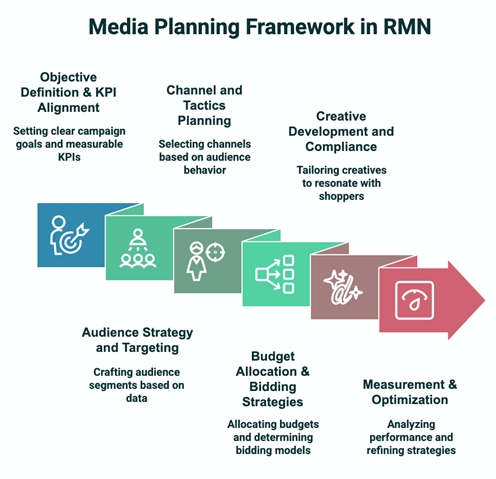
In RMNs, building on successful media plans and customized based on brand requires a robust framework. Below are six sequential stages:
- Objective and Key Performance Indicator Alignment: A campaign starts with a clear statement of purpose which can be lifting incremental sales, expanding category share, or building awareness. The team selects concrete metrics (e.g., reach, frequency, incremental return on ad spend, in-store lift) to track progress.
- Audience Strategy: Planners turn to rich first-party data, grouping shoppers by demographics, purchase patterns, loyalty tier, or browsing signals. Many networks now supplement these segments with AI-based propensity and lookalike models that hint at future intent. Choices also balance depth among existing customers and breadth among new prospects.
- Channel and Tactics Selection: With audiences in hand, attention shifts to the best touchpoints inside the RMN. For example, sponsored search for high-intent queries, on-site display for browsing moments, or in-store digital screens for last-minute influence.
- Budget Allocation and Bidding Strategies: Historical results and platform forecasts inform how much spend flows to each tactic. Marketers juggle CPC or CPM pricing schemes, earmark a slice for experimentation, and build in flexibility to move funds when real-time data suggests a better return.
- Creative Development and Compliance: Copy and visuals are molded to fit the retail context, often highlighting price, availability or timely offers. A/B tests refine headlines and imagery, while brand guidelines and privacy rules keep every asset on the right side of policy.
- Measurement and Optimization: Lastly, disparate performance feeds end up in a unified dashboard where standardized KPIs allow apples-to-apples measurement. Test-versus-control helps in creating incrementality, and the resulting insights cycle back into fresh budgets, refined audiences, and updated creatives.
Navigating Media Planning Complexity and Challenges in RMNs
Advertisers navigating RMNs face several distinct complexities, significantly magnifying traditional media planning challenges. Key issues include:
- Fragmented Landscape: Advertisers face operational complexity due to fragmentation across RMNs, each with distinct interfaces, data structures, and targeting methods. This forces teams to juggle multiple dashboards, reconcile datasets, and manually unify performance reports, severely impacting efficiency in the absence of standardization.
- Internal Silos and Collaboration: Organizational silos between agencies, marketing, and analytics often lead to fragmented strategies and conflicting goals. This misalignment causes inefficiencies, duplicated efforts, and poor resource allocation. Aligning teams around unified KPIs and workflows is vital for effective collaboration.
- Attribution and ROI Measurement Complexity: Accurately attributing incremental sales to ad exposures is challenging. Simplistic models (e.g., last click) ignore cross-network synergies and overstate impact. Robust experimental methods, like holdout tests, are needed to determine true causal effects and accurate ROI.
- Channel Allocation Decisions: Budget optimization across tactics requires balancing reach and conversion potential. Brands must decide between focusing on one high-performing tactic or diversifying. Effective strategies must account for diminishing returns, audience overlap and shifting behaviors.
- Non-Standardized Metrics: Inconsistent KPIs and measurement protocols across RMNs hinder accurate comparison and benchmarking. Without transparency, brands lack clear insights into performance, limiting strategic decisions.
- Lack of Holistic Planning and Optimization Tools: RMN planning complexity requires integration of online/offline strategies, analytics tools, and dynamic pricing. The lack of holistic solutions leads to inefficient media buys and missed optimization opportunities.
- Limited First-Party Data View: RMNs offer detailed but siloed insights. This restricts a full view of the customer journey, requiring complex enrichment strategies and cross-platform collaboration to gain unified insights.
- Data Privacy Challenges: As third-party data declines, brands shift to first-party strategies requiring robust infrastructure. Consent management, anonymization, and compliance add complexity to targeting and measurement.
Addressing fragmentation, siloed data, measurement gaps, and privacy constraints is crucial to unlocking the strategic potential and efficiency of media planning in RMNs.
AI as the Catalyst for Enhanced Media Planning
Artificial intelligence is becoming essential for media planning in RMNs due to their inherent complexity — platform fragmentation, vast data, isolated first-party insights, and increasing demands for standardized measurement. AI addresses these challenges through automation, predictive analytics, and deeper insights, maximizing retail media's full potential.
AI-Powered Audience Targeting and Segmentation
AI significantly enhances the ability to identify and reach the right audiences within RMNs:
- Enhanced Precision: Analyzes large datasets (e.g., purchase history, browsing behavior, third-party data) to predict consumer intent and accurately identify valuable audience segments.
- Scalable Audience Building: Automates creation of detailed audience segments (e.g., behavior, demographics, psychographics), reducing manual effort using composable customer data platforms.
- Predictive and Lookalike Modelling: Anticipates future consumer actions (conversions, churn) and identifies new customers similar to high-value existing segments.
- Cross-Channel Unification: Bridges fragmented RMN data between digital and offline channels using generative modelling and probabilistic matching for real-time targeting.
Hyperpersonalization at Scale
AI is the engine enabling RMNs to deliver personalized experiences to individual consumers at a scale previously unimaginable:
- Dynamic Creative Optimization (DCO): AI automatically tests various ad creative combinations (headlines, images, CTAs) in real time, delivering personalized content that maximizes engagement and conversion.
- Tailored Recommendations and Content: AI leverages browsing history, purchase patterns, real-time behaviors, and contextual signals to generate personalized product recommendations, promotions and ads, keeping messages relevant.
- Improved Customer Experience: Personalized, timely advertising enhances the shopping experience, making ads feel helpful rather than intrusive.
- Quantifiable Benefits: AI-powered personalization boosts key business metrics, including increased ROAS, higher engagement and conversion rates, and improved customer lifetime value.
Intelligent Campaign Optimization
AI automates and refines the ongoing management of RMN campaigns:
- Automated Bidding: AI uses real-time data (e.g., user value, conversion likelihood, auction dynamics) to adjust bids automatically, optimizing KPIs such as ROAS, CPA, or CPO.
- Budget Allocation: AI recommends optimal budget distribution across campaigns, RMN platforms, channels, and time frames based on predictive analytics, with real-time budget adjustments possible.
- Real-Time Adjustments: AI continually monitors and refines targeting parameters, creative delivery, bidding strategies, and budget pacing throughout campaign lifecycles.
- Performance Forecasting: AI predicts campaign outcomes (reach, clicks, conversions) using historical data to aid strategic planning, budgeting, and "what-if" scenario analysis.
Measurement and Attribution
AI plays a critical role in addressing the complex measurement challenges inherent in RMNs:
- Tackling Incrementality: AI and machine learning (marketing mix modelling, counterfactual analysis, test-and-control methods) isolate the true incremental impact (iROAS) of RMN ads, automating experimental design and analysis at scale.
- Cross-Channel Attribution: AI analyzes multitouchpoint data (on-site, off-site, in-store) to accurately attribute conversions and present a unified view of customer journeys.
- Driving Standardization: AI-powered measurement platforms integrate diverse data sources and automate complex analyses, simplifying the adoption of standardized metrics and bridging ecosystem fragmentation.
- Fraud Prevention: AI detects anomalies indicating fraudulent activities (e.g., bot traffic, click fraud), protecting ad budgets and ensuring reliable performance metrics.

Conclusion
RMNs offer unprecedented opportunities to engage high-intent shoppers using first-party data. However, RMN media planning is beset by fragmentation, measurement gaps, privacy constraints, and organizational misalignment. This article demonstrates that AI and analytics, through predictive segmentation, robust budget optimization, unified measurement platforms, and automated creative optimization, could provide powerful solutions to these challenges. As RMNs continue to proliferate, academic and industry collaboration will be essential to refine AI-enabled media planning frameworks that balance innovation with transparency and ethical stewardship.
Abhijit Chanda is senior manager, CXM at Tredence, a global leader in data science and AI solutions.
Abhijit Chanda is a MarTech expert and AI leader with 15-plus years of experience helping global brands and Retail Media Networks turn data into growth. He builds AI-powered products and scalable analytics platforms that optimize media spend, elevate customer experiences, and unlock new revenue streams. Passionate about data-driven innovation, Abhijit thrives at the intersection of MarTech, AI, and business strategy—translating complex data into insights that drive smarter decisions and measurable impact.


