



5 Email Myths That Are Quietly Damaging Your Brand’s Reputation


Retailers are currently operating in a golden age of autonomous commerce, where artificial intelligence-driven personalization and seamless customer journeys are the standard. However, there is a massive backdoor threat that many in the sector are ignoring.
According to Valimail’s 2026 State of DMARC report, while online retail leads the world in email authentication adoption, a dangerous enforcement gap has emerged. Nearly 27 percent of the sector remains in a state of security purgatory — they have implemented the basic technical requirements to satisfy mailbox providers like Google and Yahoo, but they haven’t actually locked the door against spoofing and AI-driven fraud.
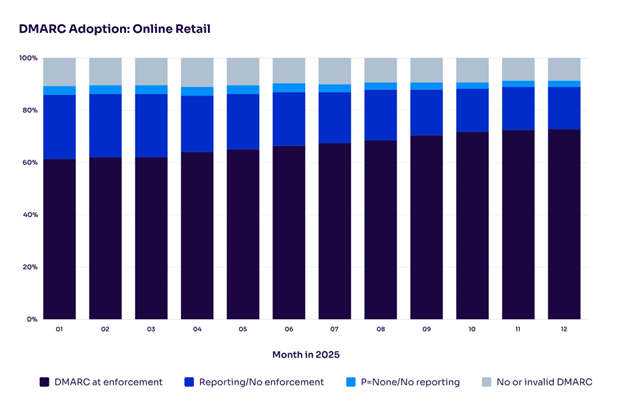
To protect your brand’s reputation and your customers’ data, it’s time to debunk five common email myths keeping retailers stuck in this enforcement gap.
Myth 1: 'We’re too small for hackers to care about our email.'
In the era of generative AI, no brand is too small for bad actors. Attackers no longer hand-craft individual phishing emails; they use automated tools to scan the web for any domain lacking a “reject” policy. To an attacker, a midsized retailer’s domain is a high-value asset that can be used to send perfectly tailored, unidentifiable fake invoices or order confirmation scams to thousands of unsuspecting customers.
Myth 2: 'If an email is fake, the spam filter will catch it.'
Traditional secure email gateways (SEGs) and spam filters hunt for malicious links and shady language. However, AI now produces perfectly professional emails that can sail past these filters. The only way to stop a sophisticated impersonation attack is at the source. If you don't have a DMARC policy set to enforcement (quarantine or reject), you're essentially allowing attackers to use your "from" address with total impunity.
Myth 3: 'We checked the box for email security last year, so we’re done.'
Many retailers reached a "reporting-only" status in 2024 or 2025 to meet new industry mandates (thank you, Google and Yahoo, for helping to drive that initial awareness and adoption!). Email senders saw the green check and simply moved on. However, a DMARC record without an enforcement policy is essentially just a road map for attackers; it shows them exactly where your defenses end. Compliance is a first step, but set-it-and-forget-it at the reporting level leaves you 100 percent vulnerable to domain spoofing.
Myth 4: 'Email security is an IT problem, not a business one.'
When a customer loses money to a phishing scam that appears to come from your brand, they don't blame your IT department, they stop shopping with you. Email is the primary driver of return on investment for most retailers. If your domain is flagged for fraud, your deliverability plummets, your marketing ROI disappears, and your brand trust fades. This is a boardroom-level risk.
Myth 5: 'Putting our logo in the inbox is just for fancy marketing.'
And now we have BIMI (Brand Indicators for Message Identification), the standard that puts your verified logo next to your email in the inbox. But it's more than a nice-to-have marketing perk. In reality, you cannot achieve BIMI without first closing the enforcement gap. That logo is a visual seal of approval that proves to the customer the email is authentic and that your domain is protected. In an age of AI fakes, that trust is a competitive advantage you can’t afford to skip.
The Bottom Line
The 2026 data shows a gap between brands that have DMARC and those that are actually protected by it. Don't let your brand be part of that statistic. Closing the enforcement gap isn't just a technical fix; it’s a commitment to protecting the most valuable asset you have: the trust (and repeat business) of your customers.
Al Iverson is the industry research and community engagement lead at Valimail, a leading email authentication solution.
- Categories:
Al Iverson is Valimail’s industry research and community engagement lead. He is also an email marketing, deliverability, and email authentication expert and the author of the blog Spam Resource.


